 PickVids
Best Fundamental physics Videos
「Fundamental physics」下面有164部被不同的人、在不同月份推荐过的视频。挑的时候先看对象:入门12部,适合还没学过的人;进阶23部,适合已经懂术语的人;普通向122部,按兴趣就能看;更硬的7部,留给想看推导或细节的人。这一类数量最多的是讲解,所以它们的共同点是用一个图像或类比把一个概念补上。常出现的频道包括Veritasium、PBS Space Time、Christopher Sykes。目录给这个主题划的范围是:Physics: classical mechanics, relativity, thermodynamics, electromagnetism, Feynman lectures, physical law, physics courses, Walter Lewin, Veritasium, physics explainers and demonstrations.如果只看三部,就从《I bought 1000 meters of wire to settle a physics debate》开始,它负责把问题讲出画面;然后看《The Speed of Light is NOT About Light》,换一种讲法或例子;最后看《Why No One Has Measured The Speed Of Light》,留给已经有基础的人。页面按每页24部切开,顺序看的是被推荐跨越了多少个月,不是播放量。每条标题下面那一句是这部片子自己的内容说明,用来区分它在讲定义、过程、演示还是观点。点进去能看到推荐原话、原文链接和适合谁看。看的时候把强烈推荐当成有人明确叫你去看,把引用当成只是拿来举例,把批评留下来对照,不要把每条评论都当成同一力度。
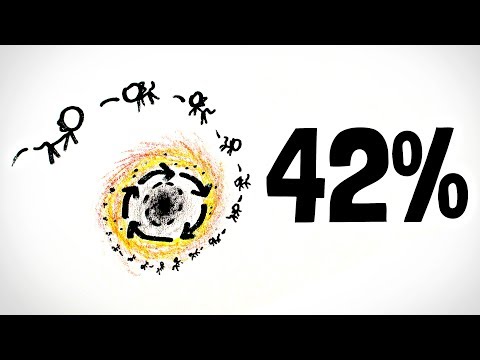
The Unreasonable Efficiency of Black Holes
Minutephysics compares how efficiently different processes convert mass to energy per E=mc^2, from fire and fission to fusion, antimatter and black holes, which can convert a large fraction of mass to energy.

Gell-Mann Amnesia and Michio Kaku
Physicist Angela Collier uses Gell-Mann amnesia to critique pop-science figures, especially Michio Kaku, and works through an eigenvalue problem along the way.
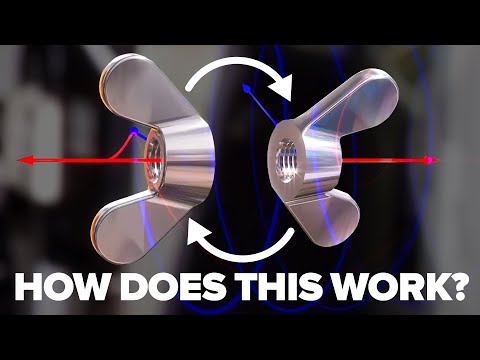
The Bizarre Behavior of Rotating Bodies
Veritasium explains the Dzhanibekov effect, also called the tennis racket theorem, where a spinning object flips unexpectedly about its intermediate axis.

Nima Arkani-Hamed: The End of Space-Time
Theoretical physicist Nima Arkani-Hamed gives a public talk on why spacetime may not be fundamental and what might replace it, including newer approaches to scattering amplitudes.
Feynman: Knowing versus Understanding
A short clip of Richard Feynman on the difference between merely knowing how to reason mathematically and understanding why physical theories work.

Does Time Cause Gravity?
PBS Space Time explores whether time causes gravity, explaining that gravity does not truly warp the flow of time but arises from time gradients.

The Snowflake Myth
Veritasium visits snowflake expert Dr Ken Libbrecht, who grows designer snowflakes in the lab.

Feynman_i_dont_like_honors_ [longer_version]
A short excerpt from a BBC interview in which Richard Feynman explains why he dislikes honors and prizes, including his own Nobel, saying the real reward is the pleasure of finding things out.

How Wrong Is VERITASIUM? A Lamp and Power Line Story
ElectroBOOM's Mehdi Sadaghdar responds to Veritasium's lamp-and-long-wire puzzle, analysing it as an electrical engineer.

Richard Feynman - The.Character.of.Physical.Law - Part 2 (full version)
Part 2 of Richard Feynman's Messenger Lectures at Cornell, The Character of Physical Law, on the relation of mathematics to physics.

I was asked to keep this confidential
Sabine Hossenfelder reads a confidential email and uses it to explain her worries about academia and incentives in theoretical physics research.

Richard Feynman Messenger Lectures at Cornell The Character of Physical Law Part 1 The Law of Gravitation
The first of Richard Feynman's 1964 Messenger Lectures at Cornell, 'The Character of Physical Law', covering the law of gravitation.

Grace Hopper on Letterman
Grace Hopper appears on Letterman and uses a foot-long piece of wire to show how far light travels in a nanosecond.

My Video Got 2 Companies Shut Down! (And even worse negative ion products)
The Thought Emporium follows up on his earlier video showing negative ion products are radioactive, reporting that Amazon pulled listings and companies shut down.

How to Detect Extra Dimensions
A PBS Space Time episode on how gravitational wave observations of a neutron star merger, GW170817, can limit the number of spacetime dimensions.

Richard Feynman "Tiny Machines" Nanotechnology Lecture - aka "There's Plenty of Room at the Bottom"
A recording of Richard Feynman's talk on the possibilities of manipulating matter at very small scales, widely seen as an early vision of nanotechnology.

levitating frog
A short clip of a frog levitating inside a roughly 10 tesla magnetic coil, demonstrating diamagnetism.
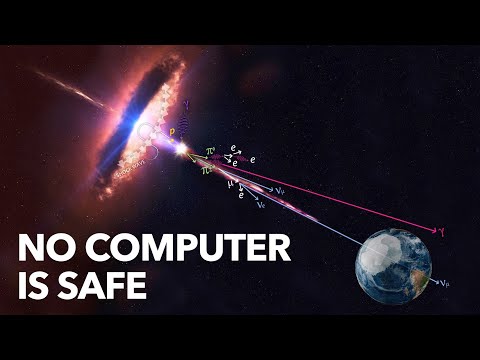
The Universe is Hostile to Computers
Veritasium explains how cosmic rays and other particles flip bits in computer memory, with examples including a Belgian election count error, plane incidents and game glitches.

Why is light slower in glass? - Sixty Symbols
Professor Mike Merrifield of Nottingham explains in a mostly uncut conversation why light travels slower in glass.
Does the Past Still Exist?
Sabine Hossenfelder explains how special relativity leads to the block universe, in which past, present and future all exist equally, and asks what that means for whether the past still exists.

Putin's new Russian MHD weapons explained (1st part)
Physicist Jean-Pierre Petit gives a long technical commentary on Russia's newly announced weapons, including the Sarmat missile, a nuclear-powered cruise missile and a nuclear MHD-propelled submarine drone.
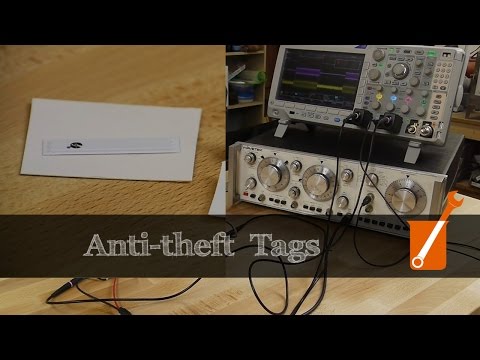
How anti-theft tags work - magnetostriction
Applied Science explains how retail anti-theft tags work.

Hitting the Sun is HARD
A three-minute minutephysics video on the orbital mechanics of why crashing into the Sun takes far more energy than leaving the solar system.

Laser diode self-mixing: Range-finding and sub-micron vibration measurement
Ben Krasnow of Applied Science shows that a plain laser diode can measure sub-micron vibrations from centimeters away using self-mixing interferometry, and can also be used for range-finding.