 PickVids
Best Quantum physics Videos
「Quantum physics」下面有57部被不同的人、在不同月份推荐过的视频。挑的时候先看对象:入门13部,适合还没学过的人;进阶15部,适合已经懂术语的人;普通向22部,按兴趣就能看;更硬的7部,留给想看推导或细节的人。这一类数量最多的是讲解,所以它们的共同点是用一个图像或类比把一个概念补上。常出现的频道包括PBS Space Time、Veritasium、The Royal Institution。目录给这个主题划的范围是:Quantum mechanics: wave function, entanglement, double slit, quantum field theory, interpretations, Sean Carroll, PBS Space Time, quantum gravity, particle physics, CERN, Higgs.如果只看三部,就从《The Quantum Conspiracy: What Popularizers of QM Don't Want You to Know》开始,它负责把问题讲出画面;然后看《Quantum Entanglement & Spooky Action at a Distance》,换一种讲法或例子;最后看《Quantum Fields: The Real Building Blocks of the Universe - with David Tong》,留给已经有基础的人。页面按每页24部切开,顺序看的是被推荐跨越了多少个月,不是播放量。每条标题下面那一句是这部片子自己的内容说明,用来区分它在讲定义、过程、演示还是观点。点进去能看到推荐原话、原文链接和适合谁看。看的时候把强烈推荐当成有人明确叫你去看,把引用当成只是拿来举例,把批评留下来对照,不要把每条评论都当成同一力度。

Lecture 1 | The Theoretical Minimum
Leonard Susskind opens Stanford Continuing Studies' Theoretical Minimum series with an introduction to quantum mechanics, a course for people who want real physics rather than popularization.
Hawking Radiation
PBS Space Time explains Stephen Hawking's prediction of Hawking radiation and how black holes can emit radiation and slowly evaporate.

Do we have to accept Quantum weirdness? De Broglie Bohm Pilot Wave Theory explained
Looking Glass Universe explains de Broglie-Bohm pilot wave theory (Bohmian mechanics) as an alternative to the standard interpretation of quantum mechanics.

Leonard Susskind | "ER = EPR" or "What's Behind the Horizons of Black Holes?" - 1 of 2
Stanford physicist Leonard Susskind gives the first of two mini-lectures on "ER = EPR", the idea that quantum entanglement and wormholes are related.

How big is a visible photon?
Huygens Optics shows through a laser interference experiment that the question of a photon's size is really about coherence length.

Consciousness is Not a Computation (Roger Penrose) | AI Podcast Clips
Clip from Lex Fridman's podcast with Roger Penrose in which Penrose argues that consciousness is not a computation.
The Higgs Mechanism Explained | Space Time | PBS Digital Studios
PBS Space Time explains the Higgs field and how the Higgs mechanism gives particles mass within quantum field theory.
The Holographic Universe Explained
A PBS Space Time episode explaining the holographic principle: the idea that our 3+1 dimensional universe may be described by information on a lower-dimensional boundary.

Turning Waves Into Particles
Huygens Optics explores the idea that space is a non-linear elastic medium, and uses simulations to show how wave energy might be confined locally into particle-like objects.
Quantum Entanglement and the Great Bohr-Einstein Debate | Space Time | PBS Digital Studios
PBS Space Time explains the Bohr-Einstein debate over quantum mechanics and how quantum entanglement settled it.

There’s No Wave Function? | Jacob Barandes
Physicist Jacob Barandes discusses his view that quantum mechanics can be formulated without wave functions, using a stochastic, probabilistic approach.

The Strangest Implication of Quantum Mechanics
A Veritasium video that follows the principle of least action from Bernoulli and Newton to quantum mechanics, asking whether light takes all possible paths at once.

David Deutsch on Physics Without Probability
A 2015 talk by David Deutsch with slides and audio about constructor theory and how physics, in particular the many-worlds interpretation, can be framed without probability.

Sir Roger Penrose & Dr. Stuart Hameroff: CONSCIOUSNESS AND THE PHYSICS OF THE BRAIN
A 2020 UC San Diego event with Roger Penrose and Stuart Hameroff presenting their Orch OR theory that consciousness arises from quantum processes in brain microtubules, followed by a conversation with Roger Bingham.
The Black Hole Information Paradox
PBS Space Time episode on the black hole information paradox, covering how black holes seem to destroy information, the no-hair conjecture and the proposed role of the event horizon.
Why Quantum Information is Never Destroyed
A PBS Space Time episode asking whether the universe's information can ever truly be lost, tying quantum mechanics, determinism and black holes together.

Quantum Field Theory visualized
ScienceClic gives a 15-minute animated introduction to quantum field theory, covering fields, spin, conserved quantities, the standard model and interactions.
Why the Muon g-2 Results Are So Exciting!
A PBS Space Time episode explaining the Fermilab Muon g-2 results and why a discrepancy with the Standard Model prediction could point to new physics.
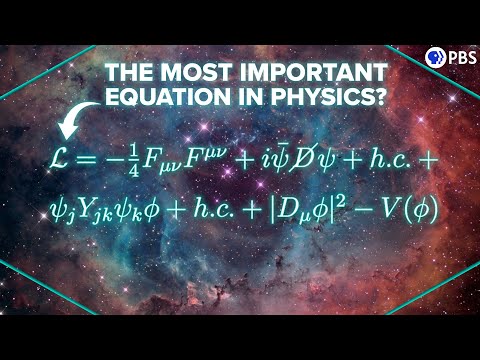
The Equation That Explains (Nearly) Everything!
PBS Space Time explains the Standard Model Lagrangian, the single equation encapsulating the particle physics theory, and visualizes what its terms mean.

The Case for String Theory - Sixty Symbols
Sixty Symbols interviews Nottingham cosmologist Tony Padilla, who says string theory deserves to be taken seriously.

What is the Ultraviolet Catastrophe?
A detailed 40-minute explanation of the ultraviolet catastrophe, covering Rayleigh and Jeans' classical treatment of blackbody radiation and Planck's quantum hypothesis.

Was Penrose Right? NEW EVIDENCE For Quantum Effects In The Brain
PBS Space Time examines Roger Penrose's idea that consciousness arises from quantum processes in the brain, and reviews new evidence about microtubules.

Does Superdeterminism save Quantum Mechanics? Or does it kill free will and destroy science?
Sabine Hossenfelder explains superdeterminism as an interpretation of quantum mechanics, addressing common objections and misconceptions, including the worry that it kills free will or science.

Something Deeply Hidden | Sean Carroll | Talks at Google
Sean Carroll's Talks at Google presentation of his book Something Deeply Hidden.