 PickVids
Best Recreational & visual math Videos
「Recreational & visual math」下面有141部被不同的人、在不同月份推荐过的视频。挑的时候先看对象:入门35部,适合还没学过的人;进阶22部,适合已经懂术语的人;普通向84部,按兴趣就能看;更硬的0部,留给想看推导或细节的人。这一类数量最多的是讲解,所以它们的共同点是用一个图像或类比把一个概念补上。常出现的频道包括3Blue1Brown、Numberphile、Stand-up Maths。目录给这个主题划的范围是:Math explainers and recreation: 3Blue1Brown, Numberphile, Mathologer, puzzles, fractals, surreal numbers, math history, mathematicians, beautiful proofs, math in everyday life.如果只看三部,就从《Vectors | Chapter 1, Essence of linear algebra》开始,它负责把问题讲出画面;然后看《But what is the Fourier Transform? A visual introduction.》,换一种讲法或例子;最后看《But what is a neural network? | Deep learning chapter 1》,留给已经有基础的人。页面按每页24部切开,顺序看的是被推荐跨越了多少个月,不是播放量。每条标题下面那一句是这部片子自己的内容说明,用来区分它在讲定义、过程、演示还是观点。点进去能看到推荐原话、原文链接和适合谁看。看的时候把强烈推荐当成有人明确叫你去看,把引用当成只是拿来举例,把批评留下来对照,不要把每条评论都当成同一力度。
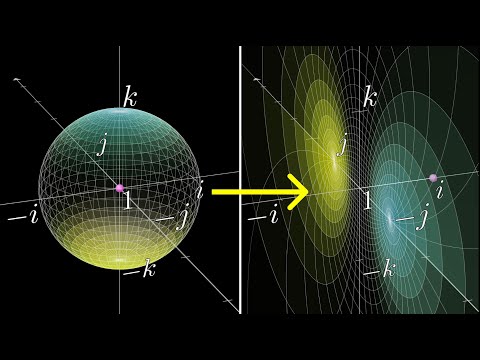
Visualizing the 4d numbers Quaternions
3Blue1Brown builds visual intuition for quaternions, showing how to think about this four-dimensional number system using stereographic projection and rotations in 3D space.

Do Chairs Exist?
A Vsauce video exploring whether chairs exist, through metaphysics, mereology and the philosophy of categorizing objects.

Why can't you multiply vectors?
Freya Holmer's Dutch Game Day 2023 talk asking why vectors can't be multiplied, building from complex numbers to a single axiom and arriving at geometric algebra, quaternions and multivectors.

Ramanujan: Making sense of 1+2+3+... = -1/12 and Co.
Mathologer examines how identities like 1+2+3+...

Stanford Lecture: Don Knuth—"A Conjecture That Had To Be True" (2017)
Donald Knuth's 2017 Christmas Tree Lecture at Stanford about a combinatorial geometry problem whose computed numbers matched a striking formula.
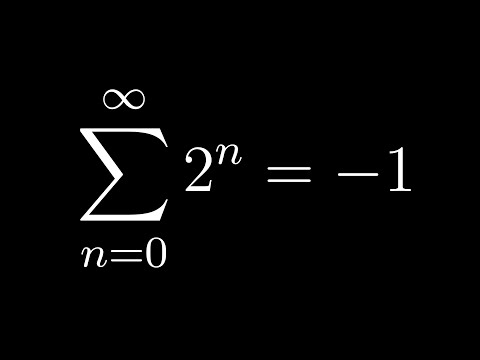
What does it feel like to invent math?
3Blue1Brown explores infinite sums from convergent to divergent, with an introduction to the 2-adic metric, themed on the cycle between discovering and inventing mathematics.
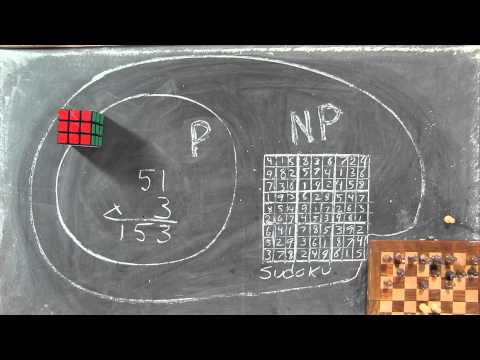
P vs. NP and the Computational Complexity Zoo
An 11-minute animated introduction to P vs.

Simulating an epidemic
3Blue1Brown builds toy SIR models to simulate how an epidemic spreads and tests scenarios like social distancing, travel restrictions, central gathering places and quarantine.

But what is the Riemann zeta function? Visualizing analytic continuation
3Blue1Brown visualizes the Riemann zeta function and the analytic continuation that extends it beyond where its series converges, building toward the Riemann hypothesis.

Who cares about topology? (Old version)
An older 3Blue1Brown video on why topology matters, built around the inscribed rectangle problem.
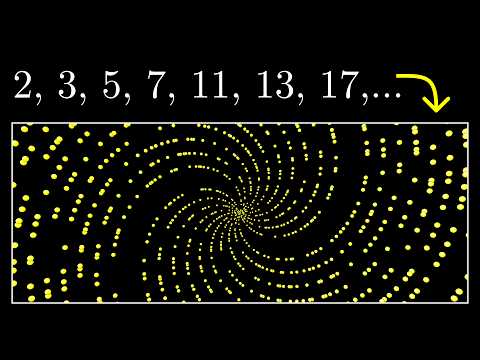
Why do prime numbers make these spirals? | Dirichlet’s theorem and pi approximations
3Blue1Brown explains why plotting primes in polar coordinates produces spiral patterns, using modular arithmetic, Dirichlet's theorem and rational approximations of pi.

How To Count Past Infinity
Vsauce's Michael Stevens takes viewers past infinity using transfinite numbers, ordinals and cardinals, with input from mathematician Hugh Woodin.
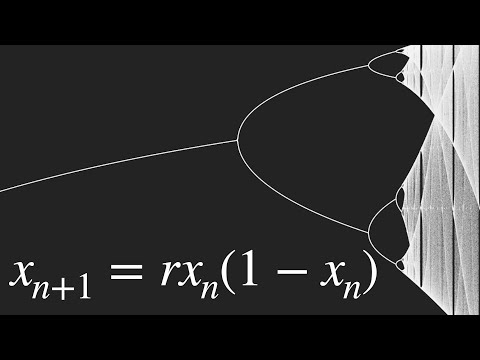
This equation will change how you see the world (the logistic map)
A Veritasium video on the logistic map, showing how a simple population equation leads to chaos and bifurcation.

Was YOUR vote counted? (feat. homomorphic encryption) - Numberphile
Numberphile interviews cryptographer Ron Rivest about end-to-end verifiable voting.
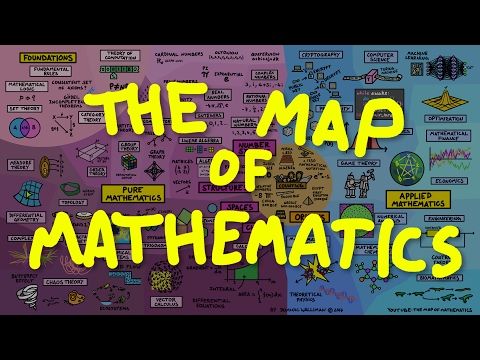
The Map of Mathematics
An animated 11-minute tour of the whole field of mathematics as a single map, showing how pure and applied math and their sub-fields relate to each other.

a better way to count
jan Misali presents an humorous but earnest case for counting in base 6 (seximal) instead of base 10 or 12, comparing the arithmetic advantages of each.
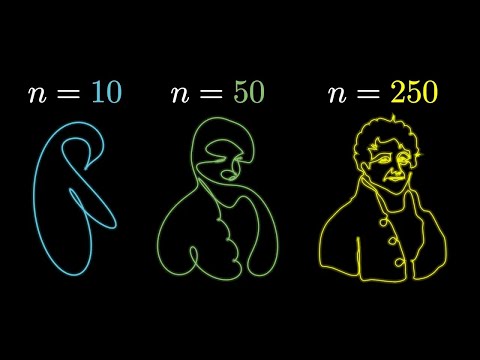
But what is a Fourier series? From heat flow to drawing with circles | DE4
3Blue1Brown introduces Fourier series, from the heat equation to drawing arbitrary shapes with rotating circles.

Triangle of Power
3Blue1Brown presents the Triangle of Power, an alternate notation that unifies powers, logarithms and roots in a single triangular symbol.

The Golden Ratio (why it is so irrational) - Numberphile
Numberphile's Ben Sparks shows why the golden ratio is the most irrational number, using seeds, continued fractions and rational approximations.

Bell's Theorem: The Quantum Venn Diagram Paradox
MinutePhysics, with 3Blue1Brown, explains Bell's theorem using a Venn diagram paradox and polarizing filters.

Why is TV 29.97 frames per second?
Matt Parker explains the history behind NTSC television running at 29.97 frames per second rather than 30, tracing it to the backward-compatible addition of color.

Hilbert's Curve: Is infinite math useful?
3Blue1Brown explains space-filling curves and the Hilbert curve, and how infinite mathematical constructions connect to finite, practical approximations.

The Infinite Pattern That Never Repeats
Veritasium explains how Penrose tilings and quasicrystals overturned the belief that 5-fold symmetry and non-periodic crystals were impossible, including an interview with Paul Steinhardt.

The Mathematics of Quantum Computers | Infinite Series
A PBS Infinite Series episode explaining the mathematics of quantum computers, including how qubits store complex numbers and how quantum computation differs from classical computation.