 PickVids
Best Computer vision, speech & NLP Videos
「Computer vision, speech & NLP」下面有93部被不同的人、在不同月份推荐过的视频。挑的时候先看对象:入门9部,适合还没学过的人;进阶25部,适合已经懂术语的人;普通向56部,按兴趣就能看;更硬的3部,留给想看推导或细节的人。这一类数量最多的是演示,所以它们的共同点是先看到做成了什么,再决定要不要追细节。常出现的频道包括Computerphile、Denis Shiryaev、Google TechTalks。目录给这个主题划的范围是:Perception and language AI: image recognition, object detection, OCR, speech recognition, text-to-speech, machine translation, natural language processing, face recognition, classical AI and expert systems.如果只看三部,就从《Bay Area Vision Meeting: Unsupervised Feature Learning and Deep Learning》开始,它负责把问题讲出画面;然后看《"Voice Driven Development: Who needs a keyboard anyway?" by Emily Shea》,换一种讲法或例子;最后看《Andrej Karpathy - AI for Full-Self Driving at Tesla》,留给已经有基础的人。页面按每页24部切开,顺序看的是被推荐跨越了多少个月,不是播放量。每条标题下面那一句是这部片子自己的内容说明,用来区分它在讲定义、过程、演示还是观点。点进去能看到推荐原话、原文链接和适合谁看。看的时候把强烈推荐当成有人明确叫你去看,把引用当成只是拿来举例,把批评留下来对照,不要把每条评论都当成同一力度。

Bay Area Vision Meeting: Unsupervised Feature Learning and Deep Learning
Andrew Ng presents unsupervised feature learning and deep learning, showing how algorithms can learn representations from unlabeled data instead of hand-designed features.

"Voice Driven Development: Who needs a keyboard anyway?" by Emily Shea
Emily Shea explains how repetitive strain injury pushed her to program by voice using speech recognition (Talon), and gives a live coding demo.

Andrej Karpathy - AI for Full-Self Driving at Tesla
Andrej Karpathy, then Tesla's head of AI, presents at ScaledML 2020 on how Tesla builds full self-driving using vision-based neural nets and fleet data collection.

Tensorflow and deep learning - without a PhD by Martin Görner
Martin Gorner's Devoxx talk introduces deep learning with TensorFlow, walking through neural networks for MNIST, how to choose an architecture and how to diagnose networks that fail to train.
JPEG DCT, Discrete Cosine Transform (JPEG Pt2)- Computerphile
Mike Pound explains the discrete cosine transform and how it underpins JPEG compression.
Fourier Optics used for Optical Pattern Recognition
Huygens Optics explains the Fourier transform and shows how a lens performs one optically.

Let's build the GPT Tokenizer
Andrej Karpathy builds the GPT tokenizer from scratch, implementing byte pair encoding along with encode and decode.
Massive-scale online collaboration | Luis von Ahn
Luis von Ahn, creator of CAPTCHA and reCAPTCHA, explains how small contributions from many people online can digitize books.

Breaking The Creepy AI in Police Cameras
Benn Jordan explains how Flock Safety's license plate cameras log and share vehicle locations, and explores how adversarial AI can defeat them.
!!Con 2017: HDR Photography in Microsoft Excel?! by Kevin Chen
A short conference talk from !!Con 2017 in which Kevin Chen explains the HDR imaging algorithm from a foundational paper, framing it as a system of linear equations, and implements it in a Microsoft Excel spreadsheet.

Dasher: information-efficient text entry
David MacKay's 2007 Google Tech Talk presents Dasher, a text-entry system driven by continuous gestures and a language model, reaching about 35 words per minute with one finger and 25 hands-free.

LSTM is dead. Long Live Transformers!
Leo Dirac explains how transformer models have replaced LSTMs in NLP.

Dual Photography
The SIGGRAPH 2005 demo of dual photography from Stanford, which swaps the roles of projector and camera to render a scene from the light's point of view.

Lecture 1 | Natural Language Processing with Deep Learning
The first lecture of Stanford's Natural Language Processing with Deep Learning course, taught by Chris Manning and Richard Socher.

Stealing Baseball Signs with a Phone (Machine Learning)
Mark Rober and Jabril build an app that uses machine learning to decode baseball sign sequences.
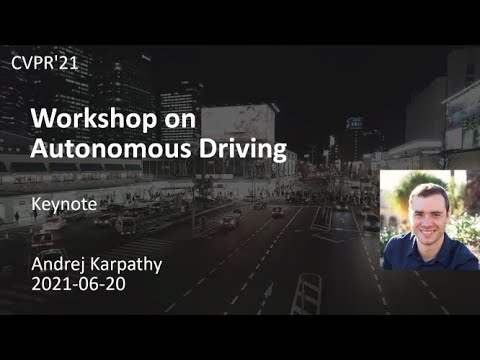
[CVPR'21 WAD] Keynote - Andrej Karpathy, Tesla
Andrej Karpathy, then Tesla's head of AI, gives a CVPR 2021 workshop keynote on how Autopilot's neural networks work.

Google Developers Day US - Theorizing from Data
Peter Norvig's 2007 Google talk on theorizing from data, covering what huge datasets can do for language understanding, translation, information extraction and inference.

Peter Norvig - The Unreasonable Effectiveness of Data
Peter Norvig's UBC distinguished lecture on how massive amounts of simple data, such as for language modeling, can yield understanding that hand-built models could not.

3D Gaussian Splatting! - Computerphile
A Computerphile video in which Dr Mike Pound and PhD student Lewis Stuart explain 3D Gaussian splatting, a quick technique that turns photos of a scene into a 3D model without much compute.

How the US Postal Service reads terrible handwriting
Tom Scott visits the USPS Remote Encoding Center in Salt Lake City, where keyers decipher mail images machines cannot read.

Speaking Piano - Now with (somewhat decent) captions!
A player piano is made to reproduce human speech, here reciting a European Environmental Criminal Court proclamation in German at the 2009 World Venice Forum.

AI Language Models & Transformers - Computerphile
Rob Miles explains on Computerphile how language models generate plausible text and how transformers improved on recurrent networks, with a look at what comes next.

This AI actually WORKS!!! - NVIDIA RTX Voice
A ShortCircuit (Linus Tech Tips) review of Nvidia's RTX Voice, which uses GPU-based neural networks to remove background noise from microphone audio.
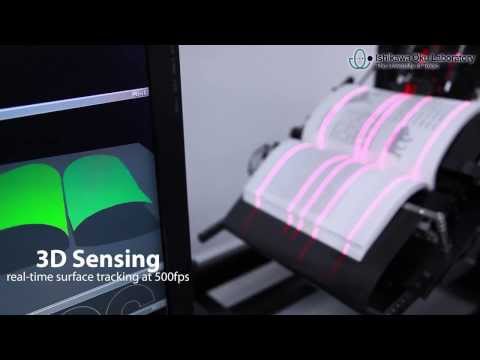
BFS-Auto: High Speed Book Scanner at over 250 pages/min
A University of Tokyo lab demonstrates a book scanner that flips pages automatically and scans over 250 pages per minute.