 PickVids
Best Cosmology & astrophysics Videos
「Cosmology & astrophysics」下面有108部被不同的人、在不同月份推荐过的视频。挑的时候先看对象:入门10部,适合还没学过的人;进阶8部,适合已经懂术语的人;普通向88部,按兴趣就能看;更硬的2部,留给想看推导或细节的人。这一类数量最多的是讲解,所以它们的共同点是用一个图像或类比把一个概念补上。常出现的频道包括PBS Space Time、Kurzgesagt – In a Nutshell、Isaac Arthur。目录给这个主题划的范围是:Cosmology and astrophysics: black holes, dark matter, dark energy, Big Bang, galaxies, stars, gravitational waves, exoplanets, the observable universe, Sabine Hossenfelder, Kurzgesagt.如果只看三部,就从《TIMELAPSE OF THE FUTURE: A Journey to the End of Time (4K)》开始,它负责把问题讲出画面;然后看《The Solar Gravitational Lens will Map Exoplanets. Seriously.》,换一种讲法或例子;最后看《Powers of Ten™ (1977)》,留给已经有基础的人。页面按每页24部切开,顺序看的是被推荐跨越了多少个月,不是播放量。每条标题下面那一句是这部片子自己的内容说明,用来区分它在讲定义、过程、演示还是观点。点进去能看到推荐原话、原文链接和适合谁看。看的时候把强烈推荐当成有人明确叫你去看,把引用当成只是拿来举例,把批评留下来对照,不要把每条评论都当成同一力度。

The Fermi Paradox Compendium
Isaac Arthur surveys the popular proposed solutions to the Fermi Paradox in a 71-minute compendium.

Telescope Building with John Dobson
A roughly 90-minute film of John Dobson building a Dobsonian telescope step by step, including hand-grinding the mirror.

VLT (Very Large Telescope) HD Timelapse Footage
A timelapse compilation of the night sky above the Very Large Telescope at Paranal, Chile, using ESO photographers' footage set to music.
The Crisis in Cosmology
PBS Space Time explains the Hubble constant tension, in which two precise, independent methods of measuring the universe's expansion rate disagree.

Is The Alcubierre Warp Drive Possible? | Space Time | PBS Digital Studios
PBS Space Time introduces Miguel Alcubierre's warp drive, explaining how spacetime itself could be warped rather than moving a ship through it, and whether it is physically possible.
Are Space and Time An Illusion?
A PBS Space Time episode hosted by Gabe Perez-Giz on the nature of spacetime and whether space and time are fundamental.
What Happens at the Event Horizon? | Space Time | PBS Digital Studios
PBS Space Time explains what happens as you approach and cross a black hole's event horizon, using Penrose diagrams and light cones as the tool for understanding spacetime there.

Hawking Radiation
PBS Space Time explains Stephen Hawking's prediction of Hawking radiation and how black holes can emit radiation and slowly evaporate.

The Halo Drive
Astrophysicist David Kipping presents the halo drive, a proposed way to propel a starship to a good fraction of light speed by gaining energy from a black hole.
Why is the Solar System Flat?
A minutephysics explainer on why the planets orbit in a flat plane.

Do Events Inside Black Holes Happen?
A PBS Space Time episode asking what black holes really are and whether events can happen inside them.

'Oumuamua Is Not Aliens
PBS Space Time examines the interstellar object 'Oumuamua and the popular theories about it, including the light-sail hypothesis.

The Fermi Paradox: Dark Forest Theory
Isaac Arthur examines the Dark Forest theory, Cixin Liu's proposed solution to the Fermi Paradox in which civilizations stay silent and may destroy any that reveal themselves.
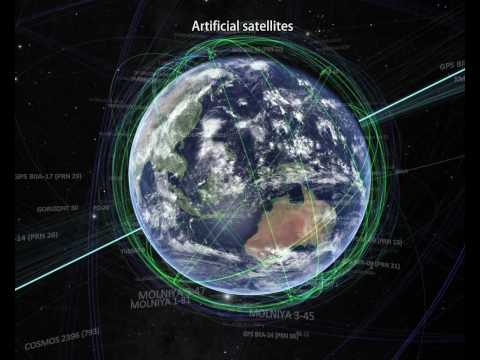
The Known Universe by AMNH #datavisualization
The American Museum of Natural History's film flies from the Himalayas out through the atmosphere and solar system to the afterglow of the Big Bang, using its Digital Universe Atlas four-dimensional map.

Leonard Susskind | "ER = EPR" or "What's Behind the Horizons of Black Holes?" - 1 of 2
Stanford physicist Leonard Susskind gives the first of two mini-lectures on "ER = EPR", the idea that quantum entanglement and wormholes are related.

Ptolemy and Homer (Simpson)
A short animation reconstructing a planet's looping orbit using Ptolemy's epicycles and deferents, with the epicycles tracing out the face of Homer Simpson.

Arcologies
An Isaac Arthur episode on arcologies, self-sufficient habitats that could house whole cities, on Earth or on harsh worlds.

Why Alien Life Would be our Doom - The Great Filter
A short Kurzgesagt animation explaining the Great Filter, the idea that finding alien life might be bad news because it implies something usually destroys civilizations.

Terence Tao on the cosmic distance ladder
Terence Tao and Grant Sanderson of 3Blue1Brown walk through the cosmic distance ladder, showing how humans measured distances from the Earth to the Moon, Sun, planets and beyond.
harvard & aliens & crackpots: a disambiguation of Avi Loeb
Physicist Angela Collier gives an hour-long critique of Avi Loeb's alien claims and reputation, placing them within the broader topic of physics crackpots.

Unlocking UAP Mysteries: Economics, Aliens, and The Great Filter | Merged EP0109
A 146-minute Merged Podcast episode in which UAP researcher Ryan Graves talks with economist Robin Hanson about UFOs.

The Holographic Universe Explained
A PBS Space Time episode explaining the holographic principle: the idea that our 3+1 dimensional universe may be described by information on a lower-dimensional boundary.

Turning the Sun Into a Giant Telescope with Dr. Slava Turyshev
Fraser Cain interviews JPL physicist Slava Turyshev about using the Sun's gravity as a lens to image distant exoplanets.

that dark matter video aged like milk
Angela Collier, a physicist, revisits her earlier dark matter video, explaining dark matter as a set of observations rather than a theory and discussing MOND comments.