 PickVids
Best Scientific method & science communication Videos
「Scientific method & science communication」下面有127部被不同的人、在不同月份推荐过的视频。挑的时候先看对象:入门2部,适合还没学过的人;进阶12部,适合已经懂术语的人;普通向113部,按兴趣就能看;更硬的0部,留给想看推导或细节的人。这一类数量最多的是讲解,所以它们的共同点是用一个图像或类比把一个概念补上。常出现的频道包括Veritasium、Angela Collier 、Christopher Sykes。目录给这个主题划的范围是:How science works: scientific method, nature of explanation, replication crisis, peer review, science communication, Feynman on explanation, popular science, history of science, scientific thinking.如果只看三部,就从《The Quantum Conspiracy: What Popularizers of QM Don't Want You to Know》开始,它负责把问题讲出画面;然后看《James Burke Connections, Ep. 1 "The Trigger Effect"》,换一种讲法或例子;最后看《Hamming, "You and Your Research" (June 6, 1995)》,留给已经有基础的人。页面按每页24部切开,顺序看的是被推荐跨越了多少个月,不是播放量。每条标题下面那一句是这部片子自己的内容说明,用来区分它在讲定义、过程、演示还是观点。点进去能看到推荐原话、原文链接和适合谁看。看的时候把强烈推荐当成有人明确叫你去看,把引用当成只是拿来举例,把批评留下来对照,不要把每条评论都当成同一力度。

The Quantum Conspiracy: What Popularizers of QM Don't Want You to Know
Ron Garret's Google Tech Talk argues that quantum mechanics is no harder to understand than relativity and that popular accounts wrongly rely on the Copenhagen interpretation.

James Burke Connections, Ep. 1 "The Trigger Effect"
The first episode of James Burke's 1978 BBC series Connections traces modern dependence on complex technological networks, starting with the 1965 New York blackout, and moves through ancient agriculture to Kuwait's oil-driven leap.
Hamming, "You and Your Research" (June 6, 1995)
Richard Hamming's 1995 recording of his talk 'You and Your Research', drawn from his graduate engineering course.

Why Being Delusional is a Superpower
Veritasium examines the role of luck in success, with simulations and examples showing how small advantages and chance can compound.
Is Most Published Research Wrong?
Veritasium explains why a large share of published research findings may be false, covering p-values, p-hacking, publication bias and low replication rates.

Richard Feynman Fire
A short clip from a Richard Feynman interview in which he explains fire, describing how burning wood releases sunlight stored by the tree, which built itself mostly from air.

Powers of Ten™ (1977)
The Eames Office's 1977 film Powers of Ten starts at a picnic in Chicago and zooms out by a factor of ten every ten seconds to the edge of the universe.

Feynman on Scientific Method.
A short clip of Richard Feynman explaining the scientific method: guess, compute consequences, compare to experiment, and why vague theories like astrology cannot be proven wrong.
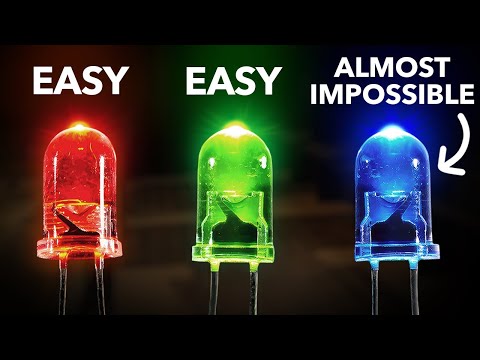
Why It Was Almost Impossible to Make the Blue LED
Veritasium tells the story of how Shuji Nakamura and others made the blue LED, long thought nearly impossible.

DEF CON 26 - Svea, Suggy, Till - Inside the Fake Science Factory
A DEF CON 26 talk by investigative journalists and hackers on the fake science industry, with bogus conferences and predatory journals that give studies false credibility.

I promise this story about microwaves is interesting.
Tom Scott investigates the claim that the microwave was invented to heat hamsters, and interviews James Lovelock about freezing and microwave-thawing hamsters in the 1950s.

The LED Traffic Light and the Danger of "But Sometimes!"
Technology Connections explains how LED traffic lights, which do not melt snow, drew complaints and were blamed for accidents.

HD Feynman: FUN TO IMAGINE complete (with optional Chinese subtitles)
A restored HD upload of the 1983 BBC series Fun to Imagine, in which Richard Feynman talks informally about everyday science.

Chicken chicken chicken
Doug Zongker's deadpan conference presentation of his famously chicken-filled paper, given at the 2007 AAAS humor session.

Veritasium: What Everyone Gets Wrong About AI and Learning – Derek Muller Explains
Veritasium's Derek Muller gives a Perimeter Institute livestream on how AI might change teaching and learning.

The Biggest Ideas in the Universe: Introduction
Sean Carroll introduces his video series on the biggest ideas in physics, such as symmetry, space and matter, as informal discussions with follow-up Q&A videos.

The Epidemic of Fake Disease
A Medlife Crisis video by cardiologist Rohin Francis on overdiagnosis and over-screening.

Feynman: Magnets (and Why?) FUN TO IMAGINE 4/ higher quality version!
A 1983 BBC interview in which Richard Feynman is asked how magnets work and explains why 'why' questions are hard to answer in everyday terms.
The Biggest Myth In Education
Veritasium debunks the idea of learning styles, such as being a visual learner, with an interview with Daniel Willingham and a memory experiment.

Bret Weinstein on "The Portal" (w/ host Eric Weinstein), Ep. #019 - The Prediction and the DISC.
A long Portal podcast episode in which Bret Weinstein tells Eric Weinstein the story of his lab mice telomere work, the prediction behind it, and what it means for science and aging.

Explained: New Navy UFO Videos
Mick West explains the three Navy UFO videos (FLIR, GIMBAL and GOFAST) released in 2020, giving mundane explanations such as a distant plane and camera artifacts.

Building a Cathedral without Science or Mathematics: The Engineering Method Explained
Bill Hammack of engineerguy explains how medieval engineers designed stone cathedrals using rules of thumb, with no science, mathematics or literacy.
string theory lied to us and now science communication is hard
Physicist Angela Collier's roughly hour-long video on how string theory was hyped to the public and what that did to science communication.

Why Greatness Cannot Be Planned — Kenneth Stanley
A long Machine Learning Street Talk interview with Kenneth Stanley, creator of NEAT and novelty search, about his book on why greatness cannot be planned.